Using Attribute-Based Access Control (ABAC) to Power Economic Equilibrium in the Age of AI
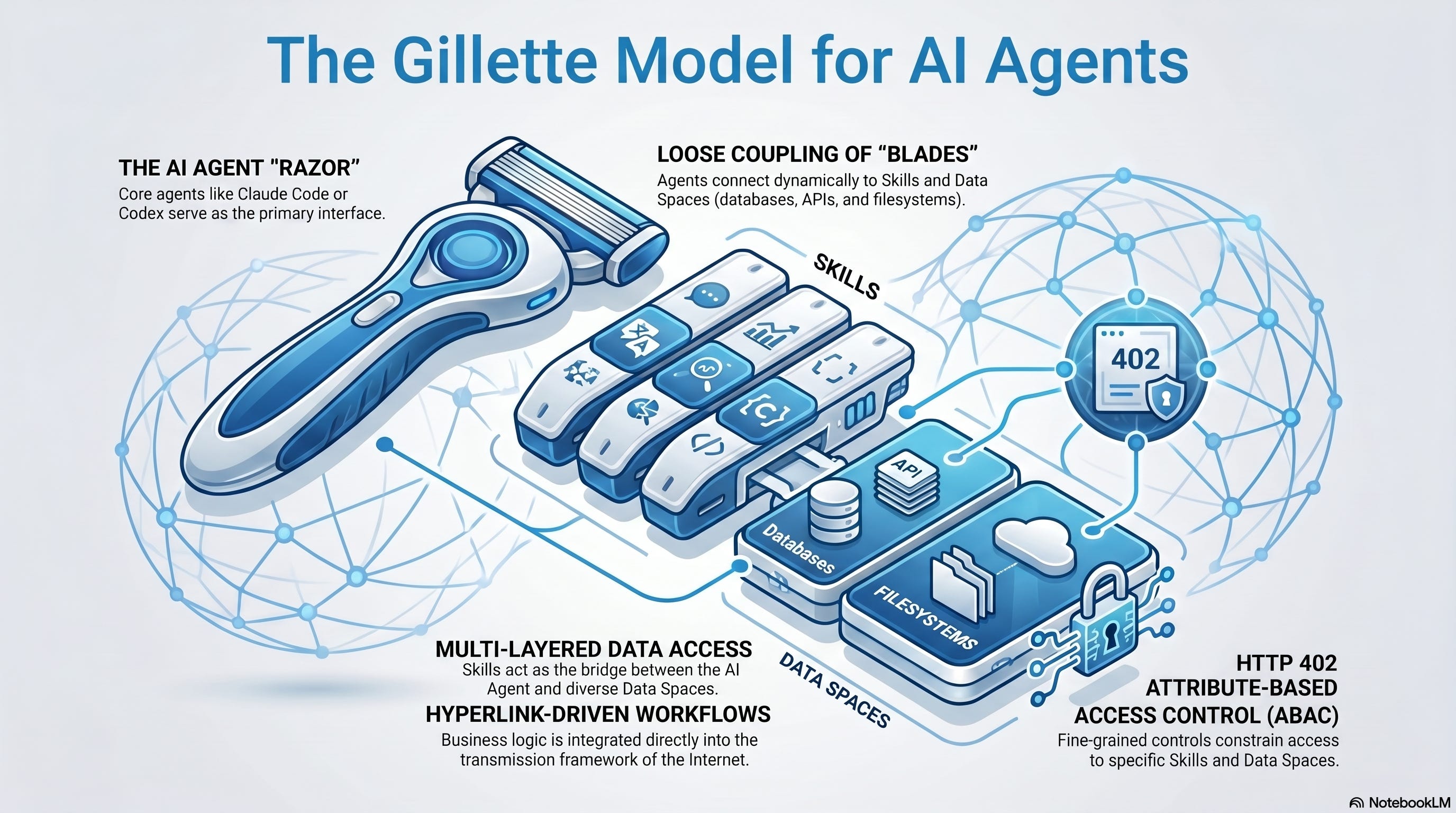
The Gillete Model for AI Agents

The Quiet Asymmetry
Long story short: at OpenLink Software we’ve seen this movie before—it’s an age-old battle to capture your data, information, and knowledge for $0.00, and then sell it back to you for a profit.
That asymmetry hasn’t disappeared in the age of AI; it has intensified. The difference now is scale. AI agents can ingest, synthesize, and repurpose vast amounts of data at speeds and volumes that were previously unimaginable.
Today’s LLM-centric business model makes this explicit:
People and enterprises publish content to the Web
LLMs ingest that content for training
Model providers monetize access on a per-token basis, with pricing calibrated competitively
What we see is simple: value is captured downstream while extracted upstream—without compensation. The very substrate that makes these systems useful is treated as a free input. That asymmetry isn’t just unfair; it’s economically unstable.
It also exposes a deeper architectural reality: the Internet was designed for transport, not negotiation.
The Web began to address this—especially through the Semantic Web project, which introduced the foundations for identity, machine-readable data, and policy expression. In effect, it put the pieces in place for negotiation.
What’s been missing isn’t capability—it’s necessity.
And now, we have it.
So we’ll say this plainly:
Do not offer your data, information, and knowledge to AI agents for free.
Complexity as a Control Mechanism
In our view, one of the more subtle—and genuinely dangerous—patterns in our industry is the use of “complexity” as a lever. It nudges people and organizations into relinquishing control, effectively making vendors their trustees.
At its core, this comes down to identity—and who controls it.
Since the early days of the Internet and the Web, interacting with software (especially cloud-hosted software) has often meant surrendering control of the identifiers that name you and anchor your digital presence.
Complexity drives a desire for convenience. Convenience leads to compliance. Compliance drifts into complacency.
The end result is predictable: erosion of control, erosion of privacy, and—at scale—collective vulnerability. That vulnerability is what fuels recurring concerns about AI risks whenever the societal impact of these systems is scrutinized.
The Mechanism of Choice
We don’t see ABAC as just a security model. We see it as an economic instrument.
Attribute-based access control enables decisions based on:
Who is requesting access (identity)
What is being requested (resource characteristics)
Under what conditions (context, purpose, intent)
That’s not just authentication and authorization. That’s programmable control over the terms of engagement.
When applied properly, ABAC activates what the Web already made possible: not just access to data, but negotiation over its use.
From Access Control to Economic Control
Once access becomes a control surface, the economic implication becomes obvious:
You monetize access to your data, information, and knowledge.
Instead of open-ended extraction, AI agents encounter governed interfaces—data spaces where access is conditional, metered, and priced.
This leads to a different model:
People and enterprises publish content governed by ABAC policies and bound to explicit access offers
LLMs (and other user agents) negotiate access at request time, including payment where required
Model providers continue to charge per token—but no longer with $0.00 input costs
This isn’t a marginal improvement. It’s a structural shift from unilateral ingestion to negotiated exchange.
Pricing can take many forms:
Per query
Per dataset segment
Per inference or transformation
Per time-bound access window
The key shift is conceptual: access is no longer implicit and free—it is explicit, negotiated, and valued.
AI agents don’t break under this model—they adapt. They budget, prioritize, and optimize for cost versus value like any other economic actor.
Why This Matters Now
For years, we’ve viewed the Semantic Web as technically sound—but economically incomplete.
What it lacked wasn’t capability. It lacked a forcing function.
LLMs provide that.
Their business models—and their well-known limitations, including hallucinations—create immediate demand for high-quality, governed data. Without identity, policy enforcement, and compensation, that demand is satisfied through extraction rather than exchange.
This is where everything clicks into place.
ABAC, identity protocols, and machine-computable offers provide the primitives for:
Expressing usage rights in machine-computable form
Enforcing those rights at access time
Enabling automated negotiation between agents
Why This Works
AI systems will always need high-quality data. There’s no workaround for that.
Models degrade without fresh, relevant, authoritative inputs. Synthetic data helps—but it doesn’t replace reality.
That persistent demand is leverage.
If access to valuable data is governed instead of freely given, an equilibrium starts to emerge—one where producers are compensated and consumers make rational trade-offs.
This is the critical shift: moving from extraction to negotiation.
Technology That Makes This Possible
This isn’t theoretical for us. This is exactly what we’ve been building.
At OpenLink Software, our stack reflects how these pieces come together in practice:
Data Spaces (Storage + Semantics)
With Virtuoso, we unify relational data, knowledge graphs, and documents into a single, queryable surface. Data becomes addressable, linkable, and semantically rich.Policy Enforcement (ABAC at Scale)
We apply fine-grained ABAC directly to data spaces—down to named graphs, rows, or documents. Policies are evaluated dynamically using identity, context, and intent.Identity as a First-Class Primitive
Everything is grounded in Web-native identifiers (IRIs/URIs), which anchor subjects, objects, and agents.OpenLink AI Layer (OPAL)
OPAL bridges LLMs and data spaces, ensuring that every interaction is policy-aware. Agents don’t bypass controls—they operate through them.Protocols for Agent Interaction (MCP, A2A)
These enable agents to request access, receive offers, and complete transactions—turning negotiation into an operational reality.
Taken together, this transforms data access into a governed, transactional interface—where requests can be evaluated, priced, accepted, or denied in real time.
From our perspective, the infrastructure for moving from extraction to exchange isn’t missing—it’s already here.
Toward Economic Equilibrium
What we’re describing isn’t restriction for its own sake—it’s balance.
Data producers retain agency and capture value
AI agents gain reliable, high-quality inputs
Markets form around access, not extraction
That’s economic equilibrium: incentives aligned instead of opposed.
If we continue with unrestricted, zero-cost access, we reinforce the imbalance—and accelerate its consequences.
The Emerging Market Layer
We expect markets to emerge where individuals and enterprises purchase skills that operate over data spaces and plug into their preferred agents.
ABAC will enforce the terms of those offerings—governing how skills interact with data and under what conditions.
What we’re seeing is loosely coupled software:
Agents with capabilities packaged as skills
Skills that perform tasks
Data spaces those skills operate over
Together, they define a new class of agentic systems: software that orchestrates operations over governed data spaces.
A Practical Imperative
This isn’t theoretical—and it isn’t optional.
If you control a data space, you already have the ability to:
Define access policies
Attach economic terms
Enforce them through machine-computable logic
The real question is whether you choose to use that capability.
Because in the age of AI, your data will be used.
The only question that matters is:
Will it be used on your terms?